
How to Check Criminal History in Corpus Christi
A useful Corpus Christi criminal record check begins with the office that made the record. Corpus Christi Police Department holds its incident and arrest narratives. Municipal Court holds city ordinance, traffic, and fine-only Class C files. Nueces County Jail records a booking, while the District Clerk preserves later Class A, Class B, and felony cases. The Texas Department of Public Safety adds eligible reported events to its statewide system. One search cannot stand in for all five sources.
- Review Corpus Christi Police Open Data or the daily blotter for recent city activity.
- Request the police report from CCPD with the incident number, date, place, and involved parties.
- Search Corpus Christi Municipal Court for a city citation, docket, or warrant.
- Call Nueces Jail Information and search the county Smart Search when an arrest may have led to booking or prosecution.
- Use the official DPS public site or the DPS fingerprint review route for the appropriate statewide record.
Search results should be matched by more than a name. Compare date of birth where lawfully displayed, cause or incident number, court, charge, and outcome. For a wider county explanation, the Nueces County criminal history overview separates local case records from statewide criminal-history products.
Corpus Christi Police Record Tools
The city gives Corpus Christi readers an unusually clear starting point. Its public-records hub routes police requests apart from general City Secretary requests and links Police Open Data, crime information, a daily blotter, and sex-offender data. Those tools help locate an event, but an entry is not the full officer narrative and does not state the final court result.

The city page makes the split between discovery and document access visible. Use the blotter to pin down time and incident details, then request the actual Corpus Christi police report. A city incident count also should not be described as a Nueces County crime rate because the sheriff, smaller cities, campus police, state officers, and federal agencies cover separate areas.
Corpus Christi Police Department Records
CCPD creates records for calls, investigations, citations, and arrests handled by its officers. Its police-report request page is the right channel for a city investigative narrative. Provide requester contact information, an incident or report number if known, the date, time, location, involved parties, record category, and preferred delivery method. The official crawl did not expose exact required markers for every online field, so do not guess at mandatory options.

The request screen directs a searcher to the city custodian instead of the county jail. Active-investigation details, protected victim or juvenile information, and private identifiers may be withheld or redacted. A narrow request is easier to route than a demand for every record tied to a common name.
Corpus Christi Police
Nonemergency service
311 or (361) 826-2900
Use the dedicated police-report channel for CCPD records.
City Secretary
1201 Leopard Street
Corpus Christi, TX 78401
(361) 826-3105
Corpus Christi Record Custodian Split
Two Leopard Street addresses can mislead a Corpus Christi searcher. The City Secretary at 1201 Leopard routes city public-information work, while the Nueces courthouse and jail at 901 Leopard hold county court and booking records. CCPD does not become the custodian of a jail intake merely because its officer made the arrest. NCSO does not become the owner of CCPD's investigative narrative merely because it booked the person.
| Corpus Christi record | Primary custodian | Best first channel |
|---|---|---|
| Police incident narrative | CCPD | Police report request |
| Fine-only city case | Municipal Court | Citation or docket search |
| Jail intake and custody | Nueces County Sheriff | Jail information line |
| Filed felony or Class A/B case | Nueces District Clerk | County Smart Search |
This split matters most in the first days after an arrest. A daily blotter item may exist before a county case does. A jail call may confirm custody before prosecutors select the final filed charge.
Arrests and Bookings in Corpus Christi
A Corpus Christi arrest produces several records in sequence. The officer creates an arrest or incident report. NCSO records intake at the Nueces County Jail, including the local inmate identifier, received charges, custody, and bond information that can be released. A magistrate reviews warnings, probable cause, and bail. Prosecutors may later reject, reduce, add, or replace the booking allegation.
For recent custody, call Nueces Jail Information at (361) 887-2300 with the full name and date of birth if known. Then search the county portal by Last Name, First Name. No county case result does not prove there was no arrest or that a person was released. Filing takes time. The city blotter, jail line, county case record, and CCPD report answer distinct questions.
Identifiers also change between those sources. A CCPD incident number points to the police report. A booking number or Nueces SID points to the jail intake. An SO number is a sheriff identifier that can narrow Smart Search, while a cause number belongs to a filed prosecution. A Texas State SID and a TDCJ number belong to later state systems. Keeping those labels with the office that issued them prevents a clerk from searching the wrong field.
Note: A Corpus Christi booking accusation is not proof of guilt and may not match the charge ultimately filed in Nueces County court.
Corpus Christi Citation Record Effects
Corpus Christi Municipal Court warns that paying a citation creates a judgment and conviction and may be reported to DPS. Payment is not just a fee transaction. A reader should inspect the case, understand the plea and available court options, and seek legal advice when needed before taking action that resolves the charge.
The Municipal Court page provides citation and docket routes as well as an arrest-warrant search.

The city portal concerns municipal matters. It does not replace Nueces Smart Search for filed Class A, Class B, or felony charges, and it does not provide a statewide criminal-history record.
Corpus Christi Municipal Court Records
Corpus Christi Municipal Court sits at 120 N. Chaparral Street and hears city ordinance matters, traffic cases, and fine-only Class C charges within its jurisdiction. The counter is listed from 8 a.m. to 4 p.m. on weekdays, with Thursday hours extended to 6 p.m.; its call center runs 8 a.m. to 5 p.m. at (361) 826-2500. Confirm current hours before travel.
| Court Name | Corpus Christi Municipal Court |
|---|---|
| Case Types Heard | City ordinances, traffic matters, and fine-only Class C offenses |
| Case Lookup Channel | Official Citation & Docket Search, clerk counter, or court phone |
| What the Docket Shows | City case or citation status, settings, warrants, and available payment or appearance routes |
| Higher Charges | Class A/B misdemeanors and felonies route to Nueces County courts after filing |
Read the charge and disposition, not only a broad case label. A municipal outcome can have a record effect even though the case never appears as a felony or county misdemeanor in the city portal.
Corpus Christi Warrant Resolution Records
Community Court at the Library gives Corpus Christi residents a neighborhood route to address citations, deferred disposition, payment plans, and active municipal warrants. The city also runs warrant-roundup campaigns. Dates and options can change, so the Municipal Court's current notice is the source for a particular session rather than an old news summary.
First verify the warrant with the issuing court. Ask whether a personal appearance, counsel, a bond, or a court session is required. Keep the receipt or signed order, then confirm that the court recalled the warrant and that law-enforcement status cleared. An empty online result is not enough when timing matters because recall and data updates can lag.
Active warrant: Do not approach a wanted person. Contact the issuing court or counsel about safe, lawful resolution and use emergency services when danger is present.
Where Corpus Christi Records End Up
When CCPD makes a reportable arrest, fingerprints and arrest identifiers may enter Texas's Computerized Criminal History system. The Nueces booking remains a county jail record. If prosecutors file a Class A, Class B, or felony charge, the District Clerk preserves the case register and documents. The clerk later reports a qualifying disposition to DPS so the state can link it to the arrest cycle.
Record flow: Corpus Christi Police Department › Nueces County Jail and Courts › Texas Department of Public Safety
A missing link can produce gaps. The arrest might not yet be filed, identifiers may not match, or an old disposition may not be tied to the fingerprint cycle. For self-review, compare the CCPD or jail source, the Nueces court outcome, and the DPS personal-record process rather than asking a commercial listing to change an official file.
The time span matters too. Nueces QuickLinks has digitized index books reaching back to 1850, while the modern Tyler register serves current case research. An index entry can help with genealogy or courthouse history, but it does not replace a certified judgment or a modern identity-linked DPS record. Ask the District Clerk which archive or copy channel holds the period in question.
Corpus Christi Cases Stay Local
A portal for another Nueces city does not search Corpus Christi municipal files. The distinction is clear on the Robstown Police page, which identifies a separate department and records route.

Robstown also publishes its own municipal court procedures.

Its city case lookup is likewise jurisdiction-specific.
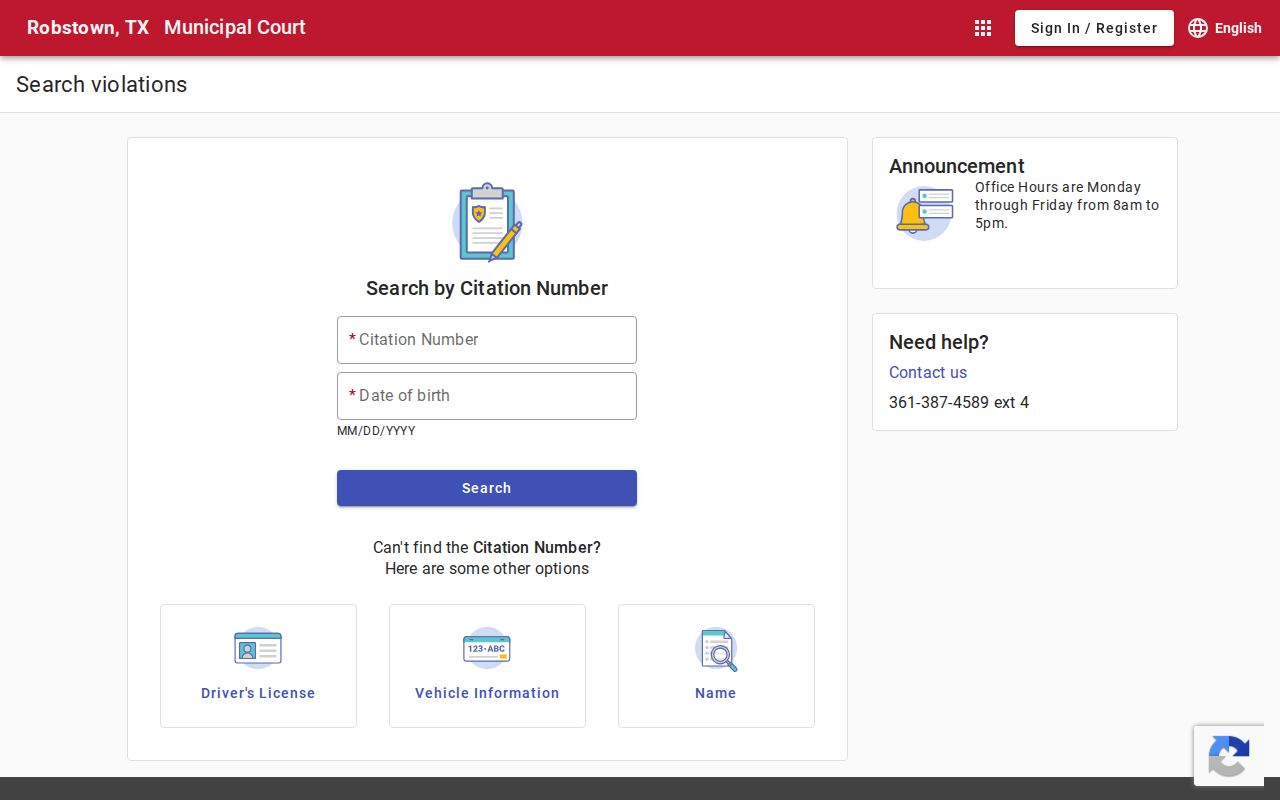
These separate official screens illustrate why a Corpus Christi search starts with Corpus Christi Municipal Court. Only county-level Class A/B or felony filings converge in the Nueces portal.
Missing Corpus Christi Criminal Cases
If no case appears, test the record's stage and court. A new CCPD event may be present only in open data, the daily blotter, or jail intake. A fine-only citation may stay in Municipal Court. A filed county charge may require the exact comma format, a date-of-birth range, case type, filing range, SO number, or booking number in Smart Search.
For an actual indictment, judgment, or signed order, the free register is not always enough. The Nueces District Clerk Criminal Division accepts a criminal-copy order by fax at (361) 888-0759 and quotes $1 per page plus $1 for certification. That county detail should remain a short escalation step on a Corpus Christi page; the Nueces criminal court case page covers the full case-file route.
Public Access Rules for Corpus Christi Records
Corpus Christi police records generally route through the Texas Public Information Act, while adjudicative case records come from the court clerk under court-record access rules. A request does not force the city to create a new report or disclose confidential juvenile, victim, active-investigation, or protected identifier data. The ten-business-day rule concerns the deadline to seek an Attorney General ruling in many withholding disputes; it is not a promise that every large request will be produced within ten days.
Key Statutes:
Texas Public Information Act gives a right to governmental records subject to stated exceptions and review procedures.
Texas Government Code Chapter 411 limits criminal-history dissemination and defines the DPS public subset.
Code of Criminal Procedure Article 15.26 makes an executed arrest warrant and supporting affidavit public subject to other law.
Use a precise date, place, event number, and record category. Ask the office that created the record. That simple routing choice avoids many delays in Corpus Christi criminal history research.
A large request for video, dispatch audio, or active investigative material may take longer and may require a cost estimate or legal review. Narrowing the time window, location, officer, and type of media lets the city identify responsive records without guessing. Court records require a separate clerk request because the Texas Judicial Administration open-records rule for administrative material is not the same as access to an adjudicative case file.